The August Jobs Report Shows a Labor Market That Refuses to Slow Down

By Tim Dillow, CFP®, Founder and President, Dillow Wealth Management
As we head into fall, the August jobs report gave us one of the more encouraging economic snapshots we've seen this year. Employers added jobs at a pace well above the recent trend, more Americans came into the workforce, and unemployment held at a level most economists would call healthy. Here's what the numbers say, and what they may mean for the economy, the markets, and your plan.
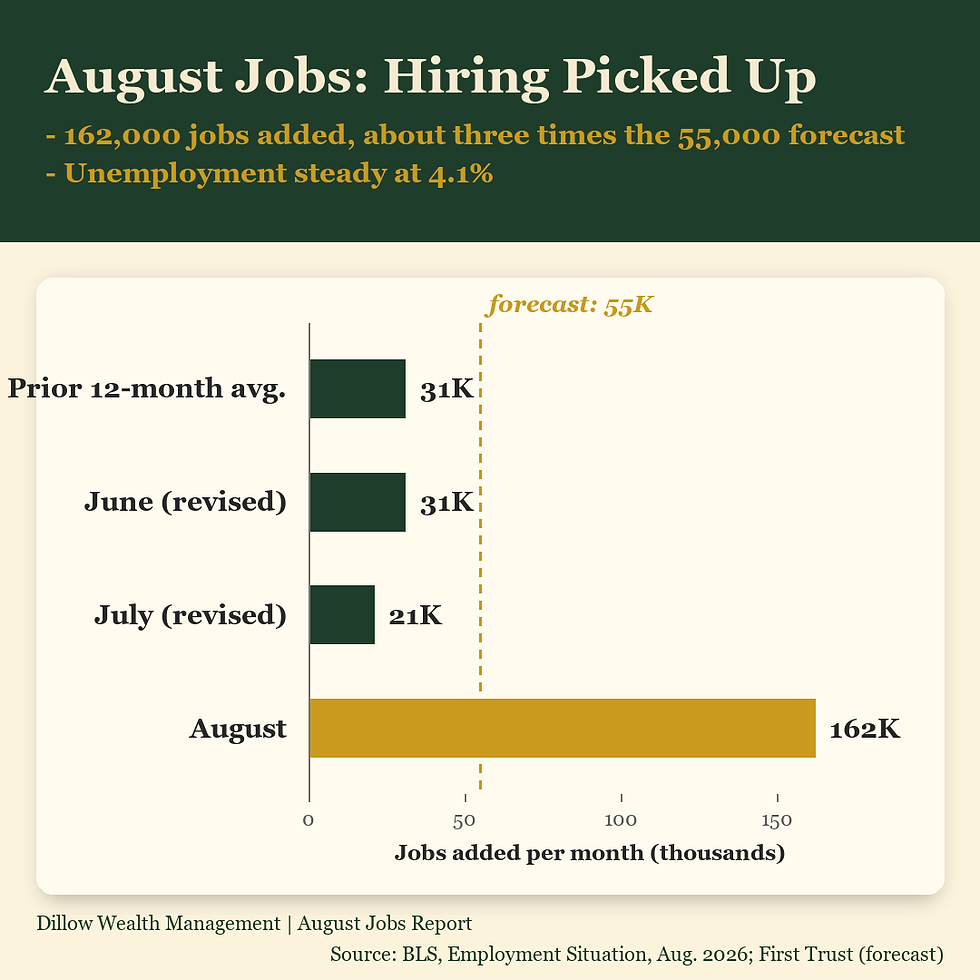
Employers added 162,000 jobs in August, far above the recent pace.
The Bureau of Labor Statistics reported that total nonfarm payrolls rose by 162,000 in August. Economists surveyed ahead of the release expected about 55,000, so August came in at roughly three times the forecast. For context, the average monthly gain over the prior twelve months was 31,000, and by First Trust's count, 2026 is now averaging about 80,000 jobs a month against roughly 20,000 in 2025. The prior two months were also revised higher: July moved from a small loss to a gain of 21,000, and June was revised up to 31,000. Taken together, the picture of a labor market losing steam over the summer looks less convincing than it did a month ago.
Unemployment stayed at 4.1% even as 683,000 people joined the workforce.
The unemployment rate was unchanged at 4.1%, with about 7.0 million people unemployed. What makes that steady rate notable is what happened underneath it: the civilian labor force grew by 683,000 in a single month. When that many people enter or re-enter the workforce and the unemployment rate doesn't budge, it means the economy absorbed them. The participation rate edged up to 61.6%, and the number of people working part time because they couldn't find full-time work fell by 414,000.
Hiring was broad, and manufacturing kept climbing.
Job gains weren't concentrated in one corner of the economy. Leisure and hospitality added 62,000 jobs, health care and social assistance added 28,000, government added 35,000, and construction added 22,000. Manufacturing added 16,000 and, in the BLS's own words, "continued its upward trend," now up 58,000 since its low last December. Not every sector grew: information lost 23,000 jobs and financial activities lost 11,000. But the breadth of hiring is what you'd expect from an economy that is still expanding rather than stalling.
The data center buildout is likely part of the manufacturing and construction story.
Manufacturing and construction employment have both strengthened noticeably in 2026. Together the two sectors have added about 145,000 jobs this year. In our view, the nationwide expansion of AI and data center infrastructure is a likely contributor, since those projects require both construction crews and the manufactured components that fill the buildings. It's a reminder that the AI investment cycle we've written about in past months shows up in payrolls, not just in stock prices.
Wages are growing at a healthy pace without overheating.
Average hourly earnings rose 0.3% in August to $37.75, and are up 3.1% over the past year. That's enough to support consumer spending while remaining well below the elevated wage growth of the post-pandemic period, which is roughly the balance the Federal Reserve has been hoping to see.
Strong data may keep the Fed cautious on rates.
A report this strong cuts both ways for investors. It reinforces the view that the U.S. economy remains on solid footing, which supports corporate earnings. It may also keep the Federal Reserve cautious on interest rates; some economists, First Trust among them, read the strength in jobs and hours as raising the odds of a rate increase this month, depending on the next inflation report. We'd caution against reading a single month as a trend in either direction. Monthly payroll numbers are revised, sometimes substantially, as the past two months just demonstrated, and the underlying pace of hiring is likely steadier than August alone suggests.
The bottom line for your plan.
Despite persistent concern about AI-related job displacement, the labor market remains healthy, workforce participation is growing, and infrastructure investment continues to support economic activity. For families with a long-term plan, this kind of report is a reason for confidence in the underlying economy, not a reason to change course. If you'd like to talk through what the current environment means for your specific situation, we're always glad to have that conversation.
This material is provided for informational and educational purposes only and does not constitute investment advice or a recommendation of any security or strategy. Economic data referenced is from the U.S. Bureau of Labor Statistics and First Trust Advisors' August Employment Report (September 4, 2026) and is subject to revision; views expressed are those of Dillow Wealth Management as of the date of publication and may change. Dillow Wealth Management, LLC is a registered investment advisor. Please visit dillowwealth.com for important disclosures.

